
For both Sam Gbaydee Doe and Al Fuertes, the vocation of peacebuilding was forged in the trauma of civil war. In Doe鈥檚 native Liberia, 10 percent of the population perished. For Fuertes, growing up on the Philippine island Mindanao, one of the world鈥檚 longest recent wars seemed 鈥渁 given.鈥�
Now, over more than a decade, both men have been familiar faces at Eastern Mennonite University鈥檚 Summer Peacebuilding Institute in Harrisonburg, Va., first as students and later 鈥� including this summer 鈥� faculty.
Doe sought a place to recover from the trauma in Liberia, as well as seek ways to prevent such disasters, when he first attended SPI In 1996.
After earning a master鈥檚 from 91短视频鈥檚 Center for Justice and Peacebuilding, Doe worked with later CJP graduate Emmanuel Bombande to launch the West African Network for Peacebuilding. WANEP works with intergovernmental bodies on human rights and education while training local volunteers to spot 鈥渆arly warning signs鈥� of violence.
Doe received 91短视频鈥檚 Distinguished Service Award in 2002 and earned a doctorate in 2010 from the UK鈥檚 University of Bradford. He has mentored fellow-African SPI alumni including Leymah Gbowee, who organized Women of Liberia Mass Action for Peace; fellow-Liberian Mack Mulbah, who established a peer mediation program; and Takwa Suifon, a research analyst from Cameroon.
Since 2005, Doe has worked for the United Nations, serving in Fiji before becoming a Development and Reconciliation Advisor in Sri Lanka in 2007. In the wake of Sri Lanka鈥檚 long civil war, challenges include resolving conflict between Tamil and Sinhalese communities.
In his 鈥淐onflict-Sensitive Development and Peacebuilding鈥� SPI course this May, Doe had students address the interrelated problems of 鈥淭ala,鈥� a fictional name for a country struggling with issues resembling Uganda鈥檚.
Students find that 鈥渄evelopment鈥� in less-powerful nations may entail profiteers exploiting a less-regulated environment: 鈥淵ou鈥檙e not building factories; you鈥檙e only taking the trees, taking the oil. It leaves a lot of people disempowered,鈥� Doe says. He hopes CJP, like WANEP, can evolve to 鈥渆ngage on the policy level.鈥�
Reflecting on a recent visit to his extended family, Doe says, 鈥淟iberia is on a path of healing, but healing takes a long time.鈥�
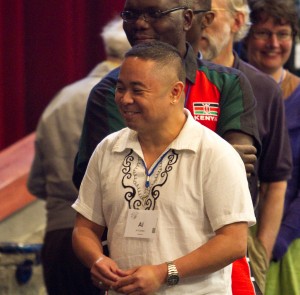
In May, as Al Fuertes finished teaching his SPI course, 鈥淭rauma Awareness and Transformation,鈥� he was preparing to lead a George Mason University student group to the Philippines, where he directs a global education program.
Fuertes was a youth-camp leader, organizer and pastor in Mindanao before his first visit to 91短视频 (then Eastern Mennonite College) as an undergraduate with the 1990-91 International Visitors Exchange Program.
He has participated in SPI as a student, dorm resident assistant, and –聽 from 2001-04 as well as this summer – teacher.
Meanwhile, Fuertes has taught for 10 years in GMU鈥檚 multidisciplinary New Century College on topics including the refugee experience, forgiveness in divided communities, trauma healing and spirituality. He earned his doctorate at GMU, where he received the 2008 Teaching Excellence Award.
Fuertes鈥� book, Community-Based Warviews, focuses on displaced communities with whom he has worked: Karen refugees (many having lived 40 years in camps on the Thai-Burmese border) and those in Mindanao. He also writes about the importance of humanitarian groups asking beneficiaries what they need rather than deciding for them. He鈥檚 working on a book that draws from his popular spirituality class.
In teaching, Fuertes employs hands-on activities, storytelling and reflection. 鈥淭rauma,鈥� he notes, is not only a clinical condition but one that affects whole communities. In SPI courses, despite the shared peacebuilding commitment, he finds, 鈥淪ome members of a class may meet people there whom they believed to be their enemies.鈥� That is how powerful learning challenges may begin.
–Chris Edwards is a free-lance writer living in Harrisonburg.