
鈥檚 11th trip to Iran marks the culmination of nearly a quarter-century of bridge-building efforts between North American Mennonites and Iranians.
Byler, who is executive director of the at 91短视频, last visited Iran in 2009, before Iran severely restricted visas for visitors from the United States and Canada for an extended period.
With the 2013 election of president Hassan Rouhani and subsequent diplomatic talks between Iran and the West, Iran鈥檚 doors have opened again.
Byler was among a 10-member group in Iran from Feb. 19 to Feb. 25, sponsored by . The delegation spent a whirlwind six days in Iran on a tightly managed schedule of workshops, meetings with religious and academic officials, and visits to sites of cultural and religious significance with the purpose of exploring 鈥渋f this is indeed a new time in which MCC work in a country often perceived as the enemy can and should be reinvigorated or even expanded,鈥� according to an MCC press release.
The delegation headquartered in Qom, a conservative-religious center of more than 1 million residents and home to more than 70,000 seminary students. From Qom, they made day-trips to Isfahan and Tehran.
Itinerary packed with fruitful conversations
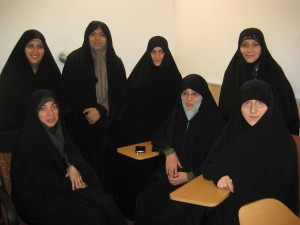
The itinerary was so packed that Byler, scrolling though photos back in his CJP office, has trouble recalling what happened on which day. He pauses between a photo of female scholars, dressed in flowing black chadors, talking in a university hallway, and a meeting room, where the delegation sits across from bearded ayatollahs in traditional turbans and black cloaks.
鈥淭his was Sunday. No, this was Monday,鈥� he says, then laughs. 鈥淲ait, I take that back. It was Sunday.鈥�
Before becoming executive director of CJP, Byler and his wife Cindy Lehman Byler represented MCC in Palestine and Israel, Iran, Iraq and Jordan from 2007 to 2013.
With only a few days in Iran on this trip, every opportunity to connect and to share with Iranians in face-to-face contacts was potentially precious, beneficial, and rejuvenating to MCC鈥檚 goals of promoting 鈥渦nderstanding, friendship, and interfaith connections between the people of Iran, Canada, and the U.S.鈥�
The MCC-Iran relationship has been growing and changing since MCC first reached out to Iran after a devastating earthquake in 1990, offering relief supplies in partnership with the Iranian Red Crescent Society. Two more relief efforts followed in 2004 and 2012, as MCC鈥檚 outreach has focused and strengthened into 鈥� through shared knowledge,鈥� according to an MCC press release.
Relationship maintained amid absence of state-level interactions
This work continues in spite of the dissolution of formal diplomatic relations with Iran by both the United States, since the Islamic Revolution in 1979, and Canada, which closed its Tehran embassy and expelled Iranian diplomats from its borders in 2012.
MCC has facilitated and supported many student exchanges, sending American and Canadian students to study in Qom, and Iranian students for advanced studies in Canada and the U.S. Ten Iranian students have attended the on 91短视频鈥檚 main campus, and two have gone on to earn their master鈥檚 degrees in conflict transformation.
MCC also started a series of academic dialogues between Mennonite and Shi鈥檃 scholars, the sixth of which will take place in May. These dialogues are now led by a network of Mennonite institutions of higher education in North America, with support from MCC. One of those scholars who has been involved in both dialogues and exchanges played an important role in this latest trip.
Dr. Mohammad Shomali, who helped secure visas, set the itinerary, and escorted the delegation on their travels, is director of the International Institute for Islamic Studies (IIIS) in Qom and also director of international affairs at Jami鈥檃t al-Zahra, the world鈥檚 largest women鈥檚 seminary for Shi鈥檃 Islam.
10 female students from Islamic seminary at 91短视频
Ten female students from Jami鈥檃t al-Zahra are expected to come to SPI this summer, escorted by Shomali and his wife, Mahnaz Heidarpour, who also teaches at the seminary.
On the first full day in Iran, the MCC delegation met seven of these women, already experienced international travelers who studied in 2012 at CMU in Winnipeg, Man. Also in the audience for a day-long workshop about peacebuilding were some of Shomali鈥檚 male students from IIIS. The students are all fluent in English and with the equivalent standing of doctoral students at North American universities, said Byler. Members of the delegation spoke on topics ranging from theological understandings of peacebuilding to church-state relations, to peacebuilding within the family and restorative justice.
During the trip, the delegation also visited with three of the 10 Iranian SPI alumni, all of whom are in prominent roles: Mohsen Ghanbari Alanagh (SPI 鈥�11), president of Al-Mustafa Open University; Mohsen Danesh Pajouh (鈥�12), completing his PhD in philosophy of religion; and Seyed Mostafa Daryabari (鈥�13), deputy of education at the International Institute for Islamic Studies.
Appreciation expressed for Summer Peacebuilding Institute
For Byler, reconnecting with SPI alumni in his new role as CJP director was a special experience, as each of these attendees said they had been deeply affected by the peacebuilding concepts shared at SPI and appreciated exploring the application of these concepts and dialogue in Iran.
鈥淎s the MCC representative, I was involved in the selection process for most of these students, so in that capacity, I knew them already,鈥� Byler said. 鈥淎s with most relationships in the Middle East, you start with one friendship and you build on that work. Those friendships continue in their importance to help us build bridges.鈥�
Subsequent days were spent in a number of introductory meetings with ayatollahs, the powerful Shi鈥檃 religious leaders who are experts in various aspects of Islamic studies.
鈥淭here were a lot of pleasantries and some theological conversations,鈥� Byler said. 鈥淎 lot of what we were doing was shaking hands and making basic introductions with powerful religious leaders, so that they could see us as who we are theologically, as Mennonites, as people who stand for peace, and then we could move forward from there.鈥�
4 91短视频 alumni among 10 in delegation
With Byler (鈥�79 and MA 鈥�85) on the delegation were 鈥�97, 91短视频 professor and MCC U.S. board chair; Rachelle Lyndaker Schlabach, MDiv. 鈥�07, MCC U.S. Washington Office director; J. Ron Byler, MCC U.S. executive director; Amela Puljek-Shank (鈥�00 and MA 鈥�04), MCC area director for Europe and the Middle East; Cheryl Zehr Walker, MCC U.S. director of communications; Ruth Keidel Clemens, MCC U.S. program director; Harry Huebner, Canadian Mennonite University professor emeritus of philosophy and theology; and Carolyne Epp-Fransen and Gordon Epp-Fransen, MCC representatives to Jordan, Iraq, and Iran.
In Tehran, the delegation met with Armenian Orthodox Archbishop Sebouh Sarkissian, who leads the largest Christian minority in Iran, as well as other supporters of interfaith dialogue: Hawnah Sadr, daughter of the late Imam Musa Sadr (known for his ecumenical outreach); Dr. Rasoul Rasoulipour, a professor at Kharazami University; and Dr. A.M. Helmi, director of the Center for Interreligious Dialogue at the Islamic Culture and Relations Organization.
Byler says MCC鈥檚 return visit to Iran is a 鈥渉opeful sign鈥� that the deep foundations of interfaith dialogue and friendship can continue to grow despite sometimes frosty diplomatic relations between Iranian and American governments.
“We have to be witnesses to the beauty of peace”
Shomali, too, shares this hope: 鈥淲e have to be witnesses to the beauty of peace,鈥� he told the delegation. 鈥淚f it can be done by people of different faiths, it can be very effective.鈥�
Though 91短视频 has regularly hosted students and visiting professors from Iran, the last 91短视频 visitor to Iran was , who was part of an MCC-led delegation in October 2008.
Byler hopes that will change this spring. In May, 91短视频 professor is scheduled to present at the 6th Mennonite-Shi鈥檃 dialogue in Qom. He鈥檒l be accompanied by director and several 91短视频 students.
鈥淚f the Iranian government also grants visas for this entire group, it will be a strong signal that we are indeed in a new day of U.S.-Iranian relations,鈥� he said.