
Nearly 100 people in South Sudan, all employees of the U.S. government, recently benefited from intensive trauma awareness and resilience trainings facilitated by 91短视频.
The -sponsored workshops in July and August introduced the approaches used by 91短视频鈥檚 for addressing trauma, breaking cycles of violence, and building individual and collective resilience, said STAR lead trainer .
Though the content was condensed and delivered in two- or three-day sessions, the workshops 鈥渁ffirm the power of the integrated STAR curriculum,鈥� Barge said. 鈥淲hen you look at conflict and violence through a trauma lens, it gives people on the ground new perspective and new possibilities.鈥�
Barge facilitated the August training in South Sudan鈥檚 capital city, Juba. She was joined by faculty member and two alumni of , (MA 鈥�06) and (MA 鈥�98), both from Kenya. Shiphrah Mutungi, a Ugandan alumnus of 91短视频鈥檚 , also facilitated.
The introductory workshops, held in Nairobi in July, were led by Ruto and a 2005 CJP grad, of , with input from CJP administrator .
Having experienced violence . . .
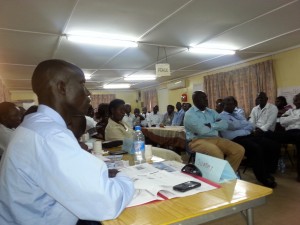
Many of the participants had recently returned to South Sudan, after having fled with their families during a December 2013 attempted military coup and related ethnic violence. This upheaval displaced more than 1 million people. The men in the workshop 鈥� almost all were male Foreign Service Nationals 鈥� were from a range of professions, including drivers, guards, program managers, office staff, doctors and lawyers.
In the six months when they were displaced, many had similar experiences of 鈥渞unning, refugee camps, and deaths in the family,鈥� one participant explained.
Many also came to the trainings preoccupied by strong feelings of anger and abandonment towards 鈥渙thers they felt had wronged them, such as the political system, the government and their employer,鈥� said Ruto. 鈥淢ost of them felt that the training would not be sufficient to resolve some of the unmet needs and grievances that had not yet been expressed.鈥�
But after activities and small-group discussions that focused on the impacts of the conflict in their personal and professional lives, workshop participants began to see these events with a new perspective.
Seeing with a new perspective
鈥淭hey realized that traumatic events are caused by multiple events, especially in a situation of war, and that the evacuation they were focused on might not have been the only traumatic event they were experiencing at the moment,鈥� Ruto said.
One participant noted that learning about the cycles of violence 鈥渉elps us understand how we keep hurting each other and why the violence/conflict hasn鈥檛 ended.鈥�
鈥淎s participants learned about more tools and developed more of an understanding of the STAR principles, they became more hopeful about how they could use this training for themselves and their families,鈥� Barge said.
Participants advocated for further exposure of trauma-resilience training beyond the 鈥渇oreign service national鈥� community served by the USAID-sponsored workshops.
More trainings wished for
鈥淭hey do not want their children to experience 21-plus years of conflict and violence, and they see that this training could play a real peacebuilding role in the region,鈥� Barge said. 鈥淚t鈥檚 important that USAID supports the development of trauma-informed staff, but the positive reaction of the participants and their recommendations to get this training to more people in South Sudan challenges USAID and CJP to do more.鈥�
Generations of South Sudanese have been affected by two civil wars lasting a total of nearly 40 years, encompassing 1955-1972 and 1983-2005. In 2005, a comprehensive peace agreement was signed. South Sudan voted for independence in January 2011 and was declared a sovereign nation six months later. Inter-ethnic warfare, a large refugee population, and internal unrest are among the young nation鈥檚 challenges.
In de-briefing sessions after the workshops, Barge said that (who recently left that role, but stays engaged with South Sudan issues) and other officials expressed optimism about the training. Discussion touched on the potential for longer and more extensive workshops for local and expatriate staffers, as well as STAR trainings for a trauma resource team and USAID employees.
Both Barge and Ruto return to South Sudan in October 2014 to lead follow-up workshops.