
After first visiting Washington D.C. in 2011, Bshara Nassar was struck by the fact that among the city鈥檚 dozens of museums, there was 鈥渘o place for the Palestinian story to be told.鈥�
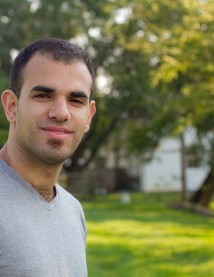
Over the next several years, as he worked on a from 91短视频鈥檚 (CJP), the thought continued to turn in Nassar鈥檚 mind. He was particularly interested in telling the little-known story of the 鈥淣akba,鈥� which means 鈥渃atastrophe鈥� in Arabic. The term is used to refer to the displacement of more than 700,000 Palestinians from their homes in 1948 when the State of Israel was created. Today, nearly 5 million people, nearly all of them descendants of the original group, are registered as Palestinian refugees with the United Nations. (Nassar鈥檚 grandmother is one, though he is not.)
Following his graduation from CJP in 2014, Nassar moved to Washington D.C. and dedicated himself to founding what he鈥檚 calling the . After a successful fundraising campaign earlier this year, that project will formally launch on June 13, 2015, with the opening of a two-week art exhibit at the Festival Center in Washington D.C.
The exhibit will feature the work of six Palestinian refugee artists. Nassar chose to use their painting and photography as the primary method of telling the refugees鈥� story because art 鈥渋s a language that everyone can understand.鈥�
鈥淭his is not about victimhood, politics or religion,鈥� said Nassar, acknowledging the controversy and divisive rhetoric that often surrounds the issue of Palestinian refugees. 鈥淲e want deep conversations that can lead to equality and justice in Israel and Palestine鈥�. I鈥檓 trying to tell stories that people haven鈥檛 heard.鈥�
Art is a common language
To do that, he鈥檚 recruited a team that鈥檚 helped with various aspects of the project. One of the artists whose work will be featured in the upcoming exhibit, painter Ahmed Hmedat, curated the show by recruiting other Palestinian artists and helping assemble their work for display. Hmedat will speak on the opening night and remain in Washington as an artist-in-residence throughout the two-week run.
Another collaborator of Nassar鈥檚 was an American Jewish friend named Sam Feigenbaum, who did the exhibit鈥檚 website and graphic design.
鈥淚 just wanted to prove that somewhere in the world that a Jew and a Palestinian could get along,鈥� said Feigenbaum, who had first met Nassar several years earlier and got back in touch with him after the outbreak of a war in Gaza last fall.
鈥淲hat鈥檚 nice about this exhibit is that it uses a means of communication that is not necessarily dependent on language or education. You don’t need to know about the Nakba in order to experience it through the art. My hope is that people will see something that hits them on an emotional level, and then start asking questions,鈥� he said.
According to CJP Executive Director , better understandings of the historical bases for conflicts, such as the Nakba, 鈥渉elps us to imagine what issues will need to be addressed in order to transform a destructive conflict into a sustainable future for the parties to the conflict.鈥�
鈥淭his project includes the tagline, 鈥楳emory and Hope,鈥� which helps cast a positive vision for a future of Israelis and Palestinians living side-by-side as neighbors,鈥� continued Byler, who along with his wife, Cynthia, is a sponsor of the upcoming exhibit. 鈥淸Nassar鈥檚] theory of change seems to be that hope for a future together is rooted in remembering the past when Jews and Arabs shared the land, largely in peace.鈥�
‘We refuse to be enemies’
Nassar emphasizes that the museum is as much focused on the present as the past, and describes the Nakba as an ongoing event for Palestinian refugees who still live in camps and for all Palestinian people who live under occupation. To address that reality in their own lives, Nassar鈥檚 family founded an organization called . Based at their 100-acre farm in the West Bank, near Bethlehem, it is dedicated to building respect and understanding between different people and cultures.
That hasn鈥檛 prevented them from living under constant fear of displacement, however. For years, the family has fought a legal battle in Israeli courts to block plans to seize parts of their land for development, and in 2014, on their farm.
In life generally, and in his efforts to found a museum to tell the Palestinian story, Nassar continues to draw inspiration from a stone at the entrance to the family farm, inscribed with the words, 鈥淲e refuse to be enemies鈥� in three languages.
鈥淚鈥檓 also inspired by CJP and the 91短视频 environment that supports and empowers peacebuilders locally and around the world. I鈥檓 deeply appreciative,鈥� said Nassar.
Although no future exhibitions have been planned beyond June, the Nakba Museum Project of Memory and Hope will be an ongoing one. One of Nassar鈥檚 biggest goals is to eventually find a permanent space to tell the refugees鈥� stories, in the service of memory and hope.