
The first students funded by a three-year, $300,000 grant from the National Science Foundation spent several weeks this summer on biosecurity research and chemistry education in Australia.
The group included six students from area universities: two from 91短视频, three from Bridgewater College, and one from James Madison University.

91短视频 students Anika Hurst and Laura Craft, now back on campus to continue their chemistry and environmental science studies, both said their individual teaching and research experiences helped to confirm where they鈥檙e headed next. Hurst hopes to do more field research, while Craft was energized by adapting her water health research learnings to lesson plans for Aboriginal learners from ages 8-18. Nicole Miller 鈥�21, a graduate of 91短视频鈥檚 chemistry program, is considering graduate school.
91短视频 chemistry professor Matthew Siderhurst is the principal investigator for the initiative, which is titled 鈥淭ephritid fruit fly Multidisciplinary Australian Research Collaboration for Biosecurity,鈥� or T-MARC-BIO for short.
Siderhurst has led insect tracking and field trapping studies stateside, in Hawaii and the Pacific region for many years.
The grant is part of the NSF鈥檚 International Research Experiences for Students program, designed to give US students multidisciplinary research experience in Australia that will advance basic science and address internationally significant challenges in biosecurity and global food supply chains. The program also aims to foster life-changing learning by enhancing interpersonal skills, empathy, and global awareness that come from living and working outside the US.
A total of six students were funded by the initiative; in addition, a recent 91短视频 graduate was supported by independent research funding. 91短视频 biology professor Jim Yoder, who has led multiple to the Pacific region, traveled with the group to connect them with Australian scientists.聽
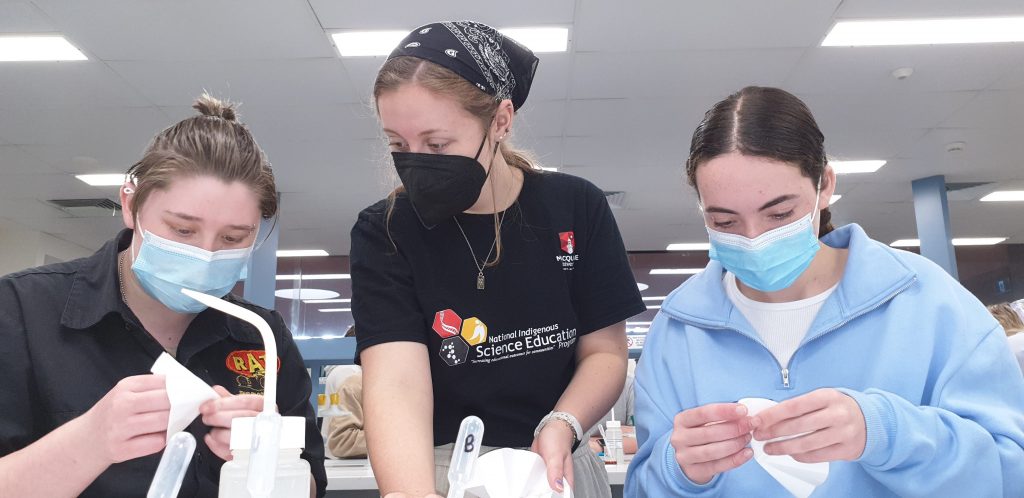
Four students were hosted by Macquarie University in Sydney, split between two labs with different foci of chemistry education, mentored by Dr. Joanne Jamie, and blowfly research, mentored by Dr. Soo Jean Park; those students were Craft, Mary Shifflett and Emily Schloss from Bridgewater College, and Jacqueline Kossey, from James Madison University.
Three others were based at Queensland鈥檚 Department of Agriculture and Fisheries headquarters in Mareeba and mentored by Stefano De Faveri and Jodie Cheesman. Their research was in tracking fruit flies with harmonic radar.
鈥淚 spent a lot of time out in the papaya field, tracking the Queensland fruit fly using a RECCO unit and flagging tape,鈥� Hurst said, of her teamwork with Allison O’Brien, a Bridgewater College student, and Nicole Miller, a 2022 91短视频 graduate.
Tephritid fruit flies are 鈥渁mong the most damaging horticultural insect pests worldwide, constituting pest management issues, trade barriers, and invasion threats for Australia, the U.S., and throughout the tropics and subtropics,鈥� according to T-MARC-BIO documents.
The student research is aimed at bolstering strategies for monitoring and controlling the invasive fruit fly species in ways that will reduce the negative impacts of pesticide use.
Having been delayed twice by COVID travel restrictions, Siderhurst was excited to see a first cohort of students begin their travel and research.
Two further cohorts of American students will be heading to Australia in 2023 and 2024.